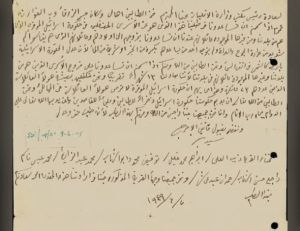
His biography was documented based on testimonies from his family. Among the most notable accounts are the following:
He grew up in Jisr al-Zarqa. He had one brother and one sister. He owned extensive tracts of land, a large portion of which he allocated to families in need and to public institutions such as schools, particularly after the Nakba and during the period of military rule.
He is considered the village’s first Mukhtar (traditional community leader) and was known for his strong national character and steadfastness. He fought alongside the Turkish army during the Ottoman era. He lived through three historical periods in the life of the village: Ottoman rule, the British Mandate, and Israeli rule.
In 1948, he lived in al-Tantura with his family for several months and witnessed the Tantura massacre, which he survived. He was subsequently arrested along with some of his sons and imprisoned at the Umm Khalid detention camp.
From his direct testimony (as cited in the analysis of survival):
“A number of Zionist soldiers came to us, and one of the officers said that if we wanted to live here, we had to surrender and not resist. I therefore asked the young fighters in the village, who were few in number, to leave and join their brothers in the Carmel Triangle and the north.
In return, the Jews handed us a very small number of rifles, while we hid the rest, fearing that the village would be occupied and that we would be expelled or killed, just as had happened to our people in the towns of the Carmel. In this way, we saved the people of the village from displacement and killing, and we outsmarted the Jews.”