Creating archives, research and documentation centers, and museums dedicated to rural heritage is not a cultural luxury, nor is it merely an attempt to preserve a few old photographs or the tools once used by our ancestors. At its core, it is an act of protecting memory, protecting people, and protecting their relationship with the place where their fathers and grandfathers lived.
A village is not merely houses, roads, and land. A village is the memory of its people: the names of fields, valleys, and springs; the shape of houses; the stones of its walls; wells; trees; agricultural tools; songs; proverbs; stories; traditions of marriage and hospitality; and even the dialect and words that may disappear if we do not find someone to preserve and document them.
For this reason, rural heritage should be viewed as a living document, rather than merely as remnants of the past.
Why Do We Need an Archive?
When a village preserves its old deeds and maps, its photographs, the testimonies of its elders, and family records, it is not merely preserving the past. It is preserving part of its story—a story that can be revisited to understand its relationship with the land and the place.
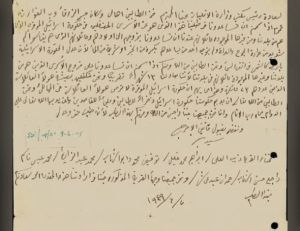
An old document may tell us where the boundaries of a particular piece of land once lay. A photograph may reveal a house that no longer exists today. The testimony of an elder may preserve the name of a place that has disappeared from official maps. An old map may reveal what the village looked like before its features changed.
At this point, the archive becomes more than a room filled with documents; it becomes an organized memory of the community.
Documenting these materials helps protect memory from loss and oblivion and gives future generations the opportunity to understand where they came from, how their parents and grandparents lived, and how their relationship with the land and their homes was formed.
Connection to the Land Begins with Knowing Its Story
It is difficult for a person to feel a deep connection to a place whose history they do not know.
When a child knows the name of the land his grandfather once cultivated, the name of the well from which the family used to draw water, the name of the valley people once crossed, the location of the old family home, and the story associated with each site, the place becomes more than a piece of land.
It becomes part of his memory and identity.
Therefore, documenting the names of places, fields, valleys, springs, cemeteries, houses, and old pathways is not merely a geographical task. It is the preservation of a map of collective memory.
Every name that disappears without being documented takes with it a part of the story of the place.
The House, Too, Is a Document
We often look at an old house as nothing more than an old structure that should be demolished or replaced. Yet, in reality, a house can tell us a great deal about the society that built it.
The arrangement of rooms, the courtyard, the storage area, the oven, the well, and the space designated for animals, as well as the type of stone or mud used in construction, all reflect the way of life, economy, social relationships, and climatic conditions in which people lived.
Even an old kitchen tells a story. An old door tells a story. And a stone bearing the marks of the builder’s hands tells a story.
Therefore, protecting an old house does not necessarily mean freezing it in time. It means understanding its value, documenting its history, and then restoring or reusing it in a way that preserves its spirit and essential features.
From Archive to Museum, and from Museum to Living Memory
A village can build an integrated system rather than relying on a single institution.
The archive collects deeds, maps, photographs, and documents and preserves them in both physical and digital forms.
The research and documentation center goes into the field, interviews elders, records oral histories, and studies place names, dialects, customs, buildings, and crafts.
The village museum transforms this memory into something people can see and touch: agricultural tools, furniture, clothing, cooking utensils, means of transportation, photographs, documents, and models of traditional houses.
The restoration center preserves buildings and traditional tools and works to pass traditional knowledge and crafts on to a new generation.
The educational center, meanwhile, brings children and young people into this memory through visits, workshops, stories, and interviews with elders.
In this way, heritage does not remain confined to closed cabinets. Instead, it becomes living knowledge passed from one generation to another.
What Should We Preserve?
We should not wait until something disappears before we begin documenting it.
It is important to collect old deeds and documents, maps, aerial photographs, and photographs of houses, fields, and roads; to record the testimonies of elders; to document the names of places and natural landmarks; and to collect agricultural, household, and craft tools.
Songs, proverbs, stories, customs, celebrations, traditional clothing, local dialects, and traditional building techniques should also be recorded.
What we do not write down today may no longer have anyone to remember it tomorrow.
More important than merely collecting these materials is digitizing them and keeping backup copies, while recording the source of every document, its date, and the person or institution that holds it, so that the materials remain searchable and available for scholarly use in the future.
Heritage Is Not Only for the Past
The mistake is to look at heritage as something that has already ended.
Heritage can also be part of the future.
A museum and an archive can open opportunities for cultural tourism, support local crafts and industries, and create opportunities for young people in research, guiding, restoration, and documentation.
When their condition and value allow, old houses can be transformed into small museums, cultural centers, or spaces for education and hospitality without losing their original character.
Here, heritage is transformed from something we merely mourn the loss of into a cultural, educational, and economic resource.
Most Importantly: The People of the Village Must Own the Project
The memory of a village cannot be built from the outside alone.
Official documents are important. Researchers are important. Universities are important. But the people of the place possess another kind of knowledge—a knowledge that does not always exist in books and maps.
The elder who knows the names of the lands, the woman who remembers the stories of houses and families, the farmer who knows the course of the old valley, and the craftsman who knows how houses were once built—all of them are not merely storytellers of memories. They are bearers of knowledge whose voices must be heard and whose testimonies must be documented.
For this reason, residents must be genuine partners in establishing and managing the archive and museum, and in determining what deserves to be documented and preserved.
Dr Mohammad Mustafa Abu Asbeh