May 26, 2018
Mohammed Alyan, head of the National Higher Committee for the Defense of the Right of Return and general coordinator of the National Higher Committee for Commemorating the Nakba, said that the march marking the 70th anniversary of the Tantura village massacre in the areas inside the 1948 borders was a clear message to everyone that the Palestinian people will not forget their displaced cities and villages. He noted that commemorating the Tantura massacre, its fall, displacement, and Nakba 70 years ago was the best evidence of this.
Alyan said, “What is particularly significant about this year’s march is the participation of people from the West Bank for the first time alongside the Arab population inside Israel, especially since we are one people.” He praised the large turnout in remembrance of the blood of the victims shed in numerous places, villages, and cities, particularly in the village of Tantura.
He pointed out that an unusual coincidence occurred on Friday, as the anniversary of the massacre coincided with Ramadan this year. The Israeli occupation authorities allowed men over the age of 45 from the West Bank, as well as women, to enter Jerusalem to pray. This effectively created a partial return for those who were able to cross into Jerusalem and then proceed to areas inside the 1948 borders, especially since they are normally prohibited by Israel from entering those areas.
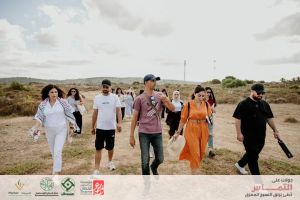
Hundreds of people participated on Friday evening in a march commemorating the 70th anniversary of the Tantura massacre, in which dozens were killed or wounded, in addition to the forced displacement of the remaining residents of Tantura in 1948.
The march was led by a Jerusalem scouting group whose members carried Palestinian flags, keffiyehs, and the names of Tantura’s victims and families. The march reached Tantura Beach, where the commemorative event began with a minute of silence and mourning for the victims, followed by the Palestinian national anthem. Memorial markers bearing the names of Tantura’s victims were placed in the sand, along with the names of victims from Gaza who were killed during the Great March of Return protests.
Member of the Knesset Jumaa al-Zabarqa said, “Our feelings today are mixed: there is grief and sorrow for the souls of the victims, but also happiness at hearing the Maghrib call to prayer in Tantura for the first time since the Nakba. This is the village whose remaining descendants continue to hold on to the memory of the horrific massacre, one that sends shivers down the spine and was committed by Zionist militias during the Nakba.”
It is worth noting that the village of Tantura is located south of Haifa, inside what is now Israel, on the Mediterranean coast. Zionist militias perpetrated one of their most horrific massacres there on May 22 and 23, killing more than 200 people in cold blood. The occupation authorities subsequently established the settlement of “Nahsholim” and a tourist resort on the ruins of the devastated village, as well as a parking lot on the site of a mass grave containing victims of the massacre.
The Tantura massacre differs from other massacres in Palestine in that it was carried out by Israeli military forces one week after the declaration of the establishment of the “State of Israel.” The army allegedly singled out the village because of its location on the Mediterranean coast, accusing its residents of having turned it into a port for supplying weapons.
https://www.youm7.com/story/2018/5/26/%D9%85%D8%B3%D8%A6%D9%88%D9%84-%D9%81%D9%84%D8%B3%D9%8A%D8%B7%D9%86%D9%89-%D8%A5%D8%AD%D9%8A%D8%A7%D8%A1-%D8%B0%D9%83%D8%B1%D9%89-%D9%85%D8 %AC%D8%B2%D8%B1%D8%A9-%D8%A7%D9%84%D8%B7%D9%86%D8%B7%D9%88%D8%B1%D8%A9-%D8%B1%D8%B3%D8%A7 %D9%84%D8%A9-%D8%A8%D8%A3%D9%86%D9%86%D8%A7-%D9%84%D9%86-%D9%86%D9%86%D8%B3%D9%89/3809618
Source: Youm7