Jisr az-Zarqa: The Popular Committee Announces the Resumption of the Struggle Against the Earth Separation Barrier
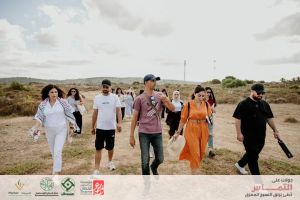
The Popular Committee for Jisr az-Zarqa announced today, Sunday, a campaign program to remove the separation wall between the Arab village of Jisr az-Zarqa and the Jewish town of Caesarea, marking the 11th anniversary of its construction.
The committee called on youth groups, social and official bodies, and political movements in the village to revive and strengthen the struggle against the earth barrier through a series of activities taking place throughout the month of December.
Unifying Popular Efforts
Sami Al-Ali, a member of the local council representing the National Democratic Assembly and head of the Popular Committee, said:
“The aim of this program and call is to renew and resume the struggle and unify official and popular efforts to confront the racist earth barrier and break the siege imposed on our village.”
Al-Ali stated that the separation barrier is part of Israeli policies of racism, discrimination, and transfer, aimed at restricting Arab citizens in their villages and towns, limiting Palestinians to the smallest possible areas, and restricting their lives in all aspects. He described it as one of the most prominent forms of oppression in recent years, similar to the separation wall built by the Israeli government between the occupied West Bank and Palestinian communities inside Israel.
He added:
“The justifications presented by Israeli authorities for building these separation barriers reveal a racist attitude toward Palestinians of ’48. These justifications include claims of protecting Jewish residents from theft and noise, ensuring their personal security, and maintaining land and housing prices in Jewish areas.”
The Wealthy City “Disturbed” by Its Arab Neighbors
In November 2002, residents of Jisr az-Zarqa were surprised by the beginning of construction of an earth barrier in the area between the Arab village and the Jewish town of Caesarea, specifically along the southern border of Jisr az-Zarqa. The barrier was built by the Caesarea Development Company and funded by it, without legal approval, without coordination with the Jisr az-Zarqa Local Council, and without informing village residents.
The earth barrier extends for 1.5 kilometers and reaches a height of 4–5 meters. Trees and plants were planted along its sides to give it a natural appearance, and a walking path was prepared along its top.
Resident Sami Fadieli, whose home is adjacent to the barrier, said:
“The Caesarea Development Company described the barrier as a soundproof wall. According to their claims, it was built in response to ‘noise disturbances’ affecting Caesarea residents due to sounds coming from Jisr az-Zarqa, such as the call to prayer, loud music, celebrations, and fireworks. These are, of course, weak excuses.”
He added that the company also claimed the barrier would protect Caesarea residents from theft and that the proximity of northern Caesarea neighborhoods to the Arab village reduced the value of land and homes in the area, particularly because Caesarea is considered a city of the wealthy.
Fadieli continued:
“We launched a popular struggle against the construction of the earth barrier, set up a protest tent near the contact area with Caesarea, and turned to Israeli courts in an attempt to prevent its construction. Unfortunately, our efforts failed, as Israeli authorities yielded to the demands of the wealthy and the military, political, and economic elites living in Caesarea today, including successive Israeli presidents and prime ministers. Current Prime Minister Benjamin Netanyahu also owns a home in Caesarea.”
Suffocation and Siege
Jisr az-Zarqa is considered the only Arab coastal village in Israel. Its population of around 13,000 residents suffers from extremely difficult economic and social conditions. The village also faces severe overcrowding and a housing crisis due to its very limited construction area. The village’s jurisdiction extends over only about 1,600 dunams, alongside poor infrastructure, shortages in many fields, and numerous social challenges.
For many years, the village has been under siege, bordered by the Haifa–Tel Aviv coastal highway to the east, the nature reserve of Nahal Taninim to the north, the separation barrier to the south, and the sea to the west.
Deteriorating Economic and Social Conditions
Bassam Mohammed Ammash, a member of the Popular Committee in Jisr az-Zarqa, explained the impact of the earth barrier:
“The earth barrier has limited the village’s expansion southward, prevented the construction of the village’s bypass road, harmed the surrounding area, blocked views of the sea and nature, created visual pollution, and contributed to frustration and depression among residents, especially those living in the southern neighborhood.”
He added:
“Jisr az-Zarqa is one of the poorest Arab towns and is ranked at level 2 on the socio-economic scale. For many years, the village has suffered from severe overcrowding, a lack of building land and public facilities, high unemployment, and neglect and marginalization by various Israeli authorities.”