Jisr az-Zarqa: Origins and Beginnings
Knooz Net – By Dr. Mohammad Aql
Jisr az-Zarqa is the only Arab village that remained on the Mediterranean coast after the 1948 Nakba. It has a small harbor where fishing boats are anchored. Just a few meters off its shoreline lies a small island known as Pigeon Island. The village is situated on a kurkar (sandstone) ridge rising between 5 and 20 meters above sea level. It is distinguished by its beautiful coastal scenery. To its south lies the city of Caesarea, and to its north flows the Zarqa River, also known as the Crocodile River. The village is located west of Israel’s Coastal Highway (Route 2), which connects Tel Aviv and Haifa, and is accessed through a narrow underpass resembling a tunnel. To improve access, an overpass road was later constructed, linking the village to the east across the highway.
The village was named Jisr az-Zarqa (“The Blue Bridge”) after the bridge built over the Zarqa River, the canal that carried water from the river to nearby Caesarea, and the watermills located there. The river itself was called Zarqa (“Blue”) because of its clear waters, which appeared blue to the eye. It was also known as the Crocodile River because it was once famous for its crocodiles. According to tradition, crocodiles devoured two horsemen during the Crusader period. The last crocodile was reportedly found in 1912, and its skeleton is still preserved in a museum.
The Salnameh (Official Yearbook) of the Province of Syria, published in 1288 AH / 1871 CE, mentions the Ghawarna Arabs within the district of Haifa, near the Arabs of Barrat Caesarea. At that time, their population numbered 160 people living in 32 houses, with six individuals able to read and write. The Ghawarna derived their name from their original homeland in the Jordan Valley (Ghor al-Urdun). From there, they spread to the villages of the Hula region, with some eventually settling in the Kabara area near the Zarqa River.
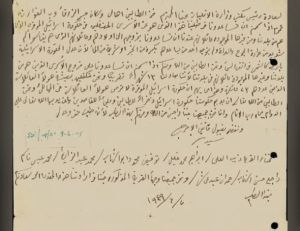
Reading an Ottoman Population Register
The Ottoman population registers, known as Asas Daftari, are an important source for studying the social history of Palestine. They are complemented by the compulsory military conscription records introduced by the Ottoman state. These documents demonstrate the Ottoman authorities’ efforts to maintain detailed administrative control over the population.
Several of these registers have survived, and previous studies have examined some of them. In this article, we examine the Asas Register of Jisr az-Zarqa, located on the Mediterranean coast.
The register records extensive personal information, including:
- The name of the village.
- The individual’s full name and family name.
- Occupation.
- Military rank.
- Father’s name.
- Mother’s name.
- Names of sons, brothers, sisters, daughters, grandchildren, wives, and dependent relatives.
- Dates of birth.
- Religious affiliation.
It is worth noting that the Ottoman clerk wrote the entries in Ottoman Turkish using poor handwriting that was extremely difficult to decipher. Considerable effort was therefore required to verify the names.
The register recorded 165 males and 131 females, making a total population of 296 persons living in 44 households. The register received its final official approval in February 1329 Rumi (Fiscal Calendar), corresponding to February 1913 CE.
All individuals listed in the register were born in Jisr az-Zarqa.
Some claim that Baron Edmond de Rothschild purchased the lands of the village of Kabara and relocated its inhabitants to the site of Jisr az-Zarqa in 1924, granting each family 32 dunams of land. This statement is accurate only regarding the residents of Kabara, who belonged to the Ghawarna Arabs. The principal families of Jisr az-Zarqa, however, had already settled there during the first half of the nineteenth century.
The register is rich in information and presents Jisr az-Zarqa as a thriving community. It clearly documents family relationships, kinship ties, and marriage connections that existed during that period, making it both historically valuable and enjoyable to study.
Heads of Households Listed in the Jisr az-Zarqa Register
- Ibrahim Mahdi Ammash – Sons: Khalil, Khamis, Jum’a, Saleh; nephew Hussein Hassan. Household: 9
- Widow Fatima Abd al-Razzaq. Household: 3
- Issa Qasim Ammash – Sons: Mithqal, Muhammad, Ahmad, Shared; servant Abd son of Shahada. Household: 14
- Daroubi Suleiman Ammash – Son Suleiman; nephew Ata son of Daoud. Household: 6
- Shahada Abdullah Al-Omran – Sons: Muhammad, Ahmad, Bishara. Household: 7
- Mufdi Mutlaq Ammash – Son Jamil. Household: 5
- Ibrahim Muhammad Ammash – Sons: Khalil, Muhammad, Ali, Gharib; grandson Shared. Household: 11
- Mahmoud Abd al-Fattah Al-Dayit – Son Al-Saeed. Household: 5
- Yahya Abd al-Fattah Al-Dayit – Sons: Yusuf, Mar’i, Muhammad. Household: 9
- Muhammad Hassan Al-Awda – Sons: Qasim, Saleh, Hassan, Khadr; brother Al-Asmar. Household: 8
- Muhammad Issa Al-Awda – Sons: Issa, Musa, Nafi’, Yunus. Household: 6
- Hussein Issa Al-Awda – Sons Ahmad and Mahmoud. Household: 6
- Ata Oweida Abu Hamed. Household: 3
- Bayen Muhammad Al-Saleh Abu Hamed. Household: 6
- Ahmad Ismail Al-Dayit – Sons: Asi, Ali, Ismail. Household: 5
- Hijris Yassin Al-Yassin (Abu Jarb) – Brothers: Mubarak, Dhib; sons: Dhiab, Hassan; nephews: Khamis, Muhammad. Household: 10
- Muhammad Khalil Yassin Al-Ajrab. Household: 1
- Yusuf Hamad Saada. Household: 3
- Hamdan Hussein Khatwan – Sons Muhammad and Shati; grandson Deeb. Household: 6
- Hassan Irhail – Brother Gharib; son Jum’a. Household: 7
- Mahmoud Saleh Ammash – Brother Daoud; son Muhammad. Household: 5
- Muhammad Abd al-Ghani Ammash – Sons: Tabash, Ramadan, Rajab; brother Madi. Household: 10
- Oweida Abd al-Fattah Ammash – Brothers Talib and Al-Abd. Household: 10
- Ishtaywi Mahmoud Ammash – Sons Mahmoud and Khalil. Household: 6
- Ahmad Mahmoud Ammash – Brother Hussein; nephew Gharib; sons Muhammad and Saad. Household: 8
- Abdullah Mahmoud Ammash – Son Ahmad. Household: 4
- Widow Amira Khalil Ammash – Husband Kanhoush; sons Bayir, Abdullah and Al-Abd. Household: 4
- Ajdei Hassan Ammash – Sons Hassan, Hussein and Hassan. Household: 9
- Shahada Khalil Ammash – Sons Jum’a, Gharib and Zaid. Household: 5
- Muhammad Khalil Ammash – Sons Hussein, Hassan and Ibrahim. Household: 7
- Ammash Yusuf Ammash – Nephew Faour son of Muflih, Faour’s children and several relatives. Household: 14
- Dhib Shkhidem – Son Dhiab; brother Shkhidem. Household: 4
- Al-Abd Abdullah Abu Hamed. Household: 6
- Yusuf Al-Darwish. Household: 4
- Mar’i Hassan Al-Zamel – Sons Ali, Faour, Ishtaywi, Ahmad and Muhammad. Household: 14
- Hassan Hassan Al-Awda – Sons Dhib and Musa; brother Muhammad. Household: 7
- Wahjan Faris Al-Qatt. Household: 5
- Abdullah Deif Allah – Son Ahmad. Household: 6
- Fallah Ahmad Ammash – Sons Nimr, Muhammad and Bayir. Household: 5
- Musa Aql Al-Awda – Son Issa; brother Hussein. Household: 7
- Ibrahim Yassin Ahmad Al-Yassin – Sons Hussein, Hassan, Ahmad and Al-Asmar. Household: 7
- Suleiman Mahmoud Al-Mahmoud – Sons Mahmoud and Abdullah. Household: 6
- Dhiab Asaad Ammash – Brother Wahba. Household: 3
- Hassan Ibrahim Abu Shahab – Brothers Hussein, Mahmoud and Ibrahim; sons Rajeh, Ali, Ta’ma and Mahawish. Household: 28