By Mohammed Mohsen Watad – Jisr az-Zarqa
The chapters of the Nakba continue in the Palestinian village of Jisr az-Zarqa inside Israel. It is the only village whose residents were not expelled by Zionist militias and which remained on the coastline. Yet, it carries within it the essence of the Palestinian issue in all its dimensions: displacement, refuge, land confiscation, settlement expansion, and restrictions through barriers, in contrast to the prosperity, resources, and living conditions provided for Israelis and every new immigrant brought to the “land of milk and honey.”
The reality of the village, with all its challenges and contradictions, reflects the circumstances of the Nakba, the core of the conflict, and the divisions affecting the Palestinian cause amid peace negotiations aimed at ending the conflict.
The village, which had approximately 12,000 dunams of land before the Nakba—most of which was confiscated for settlement purposes—now has nearly 10,000 residents living in around 2,200 housing units on an area of no more than 600 dunams. In addition, around 900 dunams surrounding the village were restricted by Israeli authorities: 500 dunams were turned into a nature reserve, while 400 dunams adjacent to the seashore were closed off from their owners, who are prevented from using or developing them.
Due to the confiscation of most of the village’s lands and the restrictions imposed on its residents, hundreds of families and young couples have been forced to leave the village, which requires around 800 additional dunams of land for construction to meet immediate housing needs.
Nakba and Resilience
Hajj Khalil Jarbaan, head of the fishermen’s village, who was 15 years old during the Nakba, says that the story of this village, which remained steadfast on the coast, summarizes the core of the Palestinian issue with all its complexities and consequences.
He still remembers the scenes of the Nakba and displacement and continues to suffer from its consequences. His relatives who joined resistance movements were displaced and now live in refugee camps in Lebanon and Jordan.
Hajj Khalil, who is married to Hajjah Siham and has 11 children, lives with five of his married children in five apartments, each no larger than 100 square meters. Like many residents, he seeks dialogue with Jewish neighbors to explain the discriminatory policies experienced by the villagers due to Israel’s policies of segregation and marginalization, hoping to convince them of the need to resolve the conflict and end the suffering of village residents that has continued since the Nakba.
He told Al Jazeera Net that the essence of the conflict with Israeli authorities is experienced in the village’s narrow streets and neighborhoods, which resemble a refugee camp. The land taken from the village was used to expand and develop neighboring Jewish communities, most notably Caesarea, where political elites, decision-makers, military leaders, and Israeli Prime Minister Benjamin Netanyahu reside.
He noted that Netanyahu avoids visiting the village and meeting his neighbors to hear their demands and witness the difficult reality they live in. Instead, he chose to build an earth barrier to isolate the village and conceal its suffering and harsh reality resulting from successive Israeli governments.
Netanyahu occasionally sends representatives to the village to make promises that residents describe as empty attempts to absorb public anger.
Conflicts and Contradictions
The village has continued to live the Palestinian cause—with its history, concerns, and heritage—as a painful reality, preserving it from disappearance.
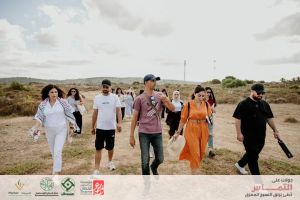
Sami Al-Ali, head of the Popular Committee, said that the Basmala Association launched a project to preserve heritage, civilization, and history, aiming to raise youth awareness of the village’s reality and the contradictions and conflicts it contains through historical storytelling, cultural activities, and educational programs that reconnect residents with their roots and homeland.
Al-Ali described to Al Jazeera Net the consequences of Israeli policies of marginalization and exclusion toward the village and its residents, which have contributed to the difficult economic and social reality. Unemployment has exceeded 40%, deepening poverty, with around 80% of residents living below the poverty line, contributing to increased crime rates exceeding 30%.
He pointed out that nearly 1,200 families out of 2,200 families in the village require social welfare services due to poverty, delinquency, and school dropout issues. The success rate in matriculation exams does not exceed 20%, while the percentage of academics is around 3%, placing the village at the bottom of Israel’s socio-economic ranking.
Al-Ali emphasized the importance of raising youth awareness about the need to strengthen their right to remain rooted in their land and place, reinforcing the resilience of residents against ongoing restriction projects, neglect, discriminatory policies, and what he described as a policy of “hidden transfer” through encouraging young couples to leave the village.
Source: Al Jazeera
To read the article, click here.