By: Suhail Makhoul – Al-Buqei’a
Introduction
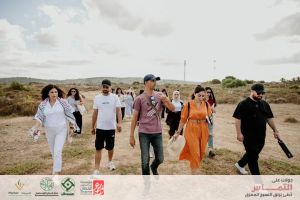
Tantura is located 24 km south of Haifa. I visited the site of the depopulated village of Tantura several times, the last being in November 2016. I was captivated by the beauty of its location, with its sandy and rocky beach. Its soft sands invite you to sit on them and play with them, while its bay has become a well-known and sought-after place for recreation. The stone house that still stands on the rocky hill near the soft sands remains, as it is the only surviving house from the village of Tantura. On the lands of Tantura, the settlement of Dor and Kibbutz Nahsholim were established.
History of Tantura
Excavations in historical Tantura indicate that there was a village called “Canaanite Dor.” It was mentioned in the 13th century BCE in an inscription relating to Ramses II, the Pharaoh of Egypt. Its name “Dor” also appears in 1100 BCE in a text written by an official in the pharaonic temple about a group that migrated to this place. It was also mentioned in the Book of Joshua 12:23: “the king of Dor in the heights of Dor, one. The king of the nations of Gilgal, one” “מֶלֶךְ דּוֹר לְנָפַת דּוֹר, אֶחָד; מֶלֶךְ-גּוֹיִם לְגִלְגָּל”. The Greeks occupied it in the late second century BCE. During the Byzantine period, the village was a site for salt production. Shipwrecks from various periods were found opposite Tantura, and coins dating back to 665 CE were discovered. During the Crusader period, a small fortress belonging to the de Merle family was built at the top of the coast. When Napoleon attempted, in the late eighteenth century, to extend his control over Palestine, his soldiers passed through the village and burned it in August 1799.
Herold, G. Buckingham, described Tantura in 1821 as a small village with a small harbor and a khan.
In 1855, Mary Rogers, the sister of the British consul in Haifa, mentioned that there were 30 or 40 houses in the village and that cattle and goats constituted the foundation of Tantura’s wealth.
By the end of the nineteenth century, its population had reached 1,200 people, and the village’s economy depended on agriculture and fishing. During the Mandate period, fishing increased from 6 tons in 1928 to 1,622 tons in 1944. In 1948, its population had reached 1,728.
Tantura fell after it was attacked by the Third Battalion of the Alexandroni Brigade of the Haganah, on the night between May 22 and May 23, 1948. After several hours of resistance by the villagers and after their ammunition ran out, the village fell into the hands of the occupation army. Its residents were initially displaced to al-Fureidis, and three weeks later they were displaced to areas under Jordanian control near Tulkarm. More than two hundred and fifty bodies were counted on the night of the occupation and in the days that followed. Many prisoners were executed and killed before they could be registered by the International Red Cross, according to several sources, stating that a massacre took place in Tantura.
Did a Massacre Actually Take Place in Tantura?
According to oral history and the records of the displaced, a massacre did indeed take place in Tantura. Haj Fawzi Mahmoud Ahmad Tanji, one of the survivors of the massacre, says and confirms that a shiver runs through him whenever he remembers how members of his family and his friends were slaughtered before his eyes. The massacre survivor confirms that the soldiers lined up between twenty and thirty young men near the house of the Al-Yahya family, one of the largest families in the village, on the seashore, and killed them. He explains how they ordered him and others to dig a trench forty meters long, three meters wide, and one meter deep. They then began taking between eight and ten men at a time to transport the bodies and throw them into the trench. When Faisal Abu Hana attempted to resist them, they killed him with rifle bayonets. According to the description, the site of the victims’ mass grave is located beneath the parking lot near the resort. There are many recorded testimonies from eyewitnesses to the occurrence of the massacre, including the testimony of Haj Mustafa and a program broadcast by Palestine Today TV, as shown in the following link:
Historian Teddy Katz presented a master’s thesis at the University of Haifa in 1998. The thesis was accepted by the university. In this thesis, he revealed the Tantura massacre, based on information available to him, and supported it with the testimony of Moti Sokler, a field guard who had been assigned the task of burying the bodies. His testimony indicates that 230 Palestinians fell in the massacre.
facebook.com/saba7.falasteen/videos/566470986861148/
Historian Teddy Katz was subjected to a defamation lawsuit by the Alexandroni Brigade, which was nicknamed the “Shabbat Unit” because most of its raids took place on Saturdays. This Haganah unit fought Teddy Katz on three fronts.
The first front was in court, where a defamation lawsuit was filed against him. The ruling was issued against Teddy Katz and included an unequivocal denial that a massacre had occurred in Tantura.
The second front was winning the trust of the public and the media. The case became the talk of the day, and the Israeli public refused to accept the idea that they had committed a massacre.
The third front was at the University of Haifa. They succeeded on this front, as the university annulled the research—the master’s thesis—submitted by Teddy Katz. This took place on April 10, 2003. The university also decided that he could not obtain a master’s degree through the research track and did not accept his revised thesis.
In the book So That We Do Not Forget by Dr. Walid Khalidi, the occupation of Tantura and the displacement of its residents are mentioned, but the massacre is not. Likewise, in the book Palestine Our Country (Nazareth, Acre and Haifa) by Mustafa Murad al-Dabbagh, there is no mention of the massacre.
In a 2013 article by Professor Alon Confino, a professor of history at the University of Virginia in the United States, he wrote about the beauty of Tantura’s location, its occupation, and the capture of its men, and how a way of life was interrupted and a new way of life took its place. He writes about the displacement to al-Fureidis of approximately 1,200 people, and how, 22 days after the fall of Tantura, they were displaced to an area under the control of the Hashemite Kingdom of Jordan—most of them settling in the Tulkarm refugee camp—in Israeli army vehicles. He mentions that the army captured 200 people but does not mention what happened to them. He does not mention anything about the massacre. At the end of the article, he includes photographs of the occupation of the village and the displacement.
As for the testimonies of Tantura survivors, they confirm that the massacre occurred and explain the absence of references to it during the Nakba as stemming from fear.
The question remains: Did a massacre take place in Tantura? I leave the answer and the decision to you.
Sources:
- זמנים גליון 121 חורף 2013 , פרפ’ א ל ו ן ק ו נ פ י נ ו – נִ סים ושלג בפלשתינה ובישראל: טנטורה, היסטוריה משנת 1948
- Palestine Remembered
Alexandroni Brigade Website
Wikipedia - Tantura – Falastinyat Association
- Source: Al-Wadiyan Website