May 23, 2015
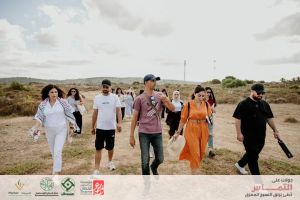
Hundreds of Palestinians from villages in the Galilee and the Triangle, along with a small number of Tantura residents who remained in the country, commemorated the Tantura massacre on Saturday for the first time since the 1948 Nakba. The event was organized by the “Palestinian Women” Association and the Association for the Displaced.
Participants walked across the ruins of Tantura, carrying olive branches and Palestinian flags. They also recited Al-Fatiha for the souls of the victims and laid wreaths at the mass grave, which today is mentioned only in the testimonies of survivors of the massacre.
The village of Tantura is located south of Haifa. Zionist militias committed a horrific massacre there on May 22 and 23, killing more than 200 people in cold blood. The Nahsholim settlement and a tourist resort were later established on the ruins of the village.
“Palestinians commemorate the 67th anniversary of the Tantura massacre inside the village for the first time.”
The Tantura massacre differs from other massacres in Palestine in that it was carried out by forces of the Israeli army one week after the declaration of the establishment of Israel. The army specifically targeted the village because of its location on the Mediterranean coast and because the military accused its residents of turning it into a port through which weapons were brought in for the Palestinian people.
Today, Palestinians are commemorating the 67th anniversary of the Tantura massacre inside the village for the first time.
Hajj Mahmoud Aamar, a witness to the massacre who now lives in Al-Fureidis, recalled:
“I was six years old at the time. I was asleep when my mother woke me, put a jacket on me, and told me that the Zionists had occupied the village. We left the house, and on the way I saw bodies and blood covering the ground. The Zionist militiamen gathered us to one side, put us into vehicles, and transported us to Al-Fureidis.”
Aamar continued:
“At first, we went to the village of Ijzim, to my father’s maternal uncles’ house. We stayed there for only one night because the next morning they told us that the Zionists had occupied Ijzim. From there, we left for Al-Fureidis, where we stayed at my father’s cousin’s house.”
In another firsthand account, Mustafa Masri, who witnessed the massacre, said:
“There were five brothers in our family. Two of my brothers were killed in the massacre, and three of us survived. I was 14 years old when 3,000 soldiers attacked our village. Some were British, mercenaries, and Zionists. At the time, there were only about 2,000 of us.”
He continued:
“The soldiers took 14 young men. They pulled me out of the group because I was young and placed me with the elderly. They also removed another young man after he proved that he was ill and was receiving treatment at a hospital in Haifa. They put us on a bus and kept us there until sunset, then took us to Al-Fureidis.”
“The Tantura massacre was one of the most brutal and horrific massacres committed by the Zionist militias in 1948.”
Suleiman Fahmawi of the Association for the Displaced also spoke, saying:
“Today, by being here in these numbers, we affirm that return is a practice and a right, not merely slogans and negotiations. It is a real return to our villages. We are here to look toward the future and affirm that we have a right to Tantura and to all our villages and cities. Here, before the victims, we pledge that we will not forgive the criminals who killed them.”
Researcher Teddy Katz, who examined the Tantura massacre in his master’s thesis and faced a fierce campaign against him within Israeli academia in 2000, also spoke. He said:
“I could talk about Tantura for an entire week. We are standing on the land of Tantura, where a horrific massacre took place. There are also more than 500 mass graves throughout the country. What happened in Tantura is deeply shameful. I am ashamed to raise the Israeli flag, which is why I carry the Palestinian flag.”
Jihad Abu Raya, director of the “Palestinian Women” Association, recalled the date of the massacre, saying:
“It took place after the declaration of the establishment of the Israeli state. The declaration was made on May 15, 1948, and the massacre took place one week later.”
Abu Raya placed full responsibility for the massacre on Israel and its army.
Israel claims that those from Tantura who were killed died during the battle. However, testimonies from hundreds of Tantura residents assert otherwise, stating that hundreds of residents were executed after the fighting had ended. They also affirm the existence of mass graves at the site.
Meanwhile, Bassel Ghattas, a member of the National Democratic Assembly, noted:
“Simply being here today, commemorating and documenting the massacres so that this becomes an annual tradition, and passing it on to the younger generation together with the facts and testimonies of people from that period—that in itself has tremendous value in preserving the narrative.”
Source: Al-Araby Al-Jadeed