August 26, 2014
The Arab village of Al-Tantura was located on the Mediterranean coast, approximately 30 km south of Haifa, with a 3-km side road connecting it to the main coastal highway. The village also had a railway station.
Al-Tantura was built on the remains of the ancient Canaanite city of Dora, whose ruins are located today to the north of the modern village. Dora was an important city during the Greek period and remained so until Caesarea surpassed it during the Roman period. It became known as a maritime commercial center between Palestine and Egypt and was famous in antiquity for silk weaving and purple dye, like other Palestinian coastal cities. During the Crusades, it served as an important defensive position, and the Crusaders built a small fortress there called Merle, the remains of which are still visible north of the village.
Al-Tantura was an archaeological area containing, in addition to one of the towers of the Frankish fortress, archaeological tells, an ancient harbor, and the remains of buildings, tombs, columns, and other architectural structures.
Near Al-Tantura were several khirbas (ruined sites), including Khirbet al-Mazra’a, Khirbet Umm al-Tus, Khirbet al-Sulaymaniyyat, Khirbet Hanata, Khirbet Dreyhima, Khirbet Haydara, and Tell Aydun. From stones taken from the ruins of these sites and from the ruins of Atlit, Ahmad al-Jazzar built his famous university in Acre in the late eighteenth century (see: Khirbas and Archaeological Sites).
The British School of Archaeology in Jerusalem conducted archaeological excavations between 1923 and 1925. These excavations uncovered a collection of pottery dating from various historical periods, beginning with the Late Bronze Age and extending to the Arab period. The excavations also revealed a destruction layer marking the transition between the Late Bronze Age and the Iron Age. This destruction appears to have affected the city during the raids that swept through the ancient Near East, historically known as the Sea Peoples’ invasions. These invasions led to the fall of many kingdoms that existed at the time, including the kingdoms of Ugarit, Alalakh, Carchemish, and others. Palestinian pottery was also discovered, representing the material remains of the Philistines who settled along the Palestinian coast.
The port of Al-Tantura was located immediately north of the modern village. It consisted of a roughly square-shaped bay measuring approximately 100 by 100 meters. A group of very small islands lies opposite Al-Tantura, extending from north to south. Wadi al-Mazra’a reaches the sea approximately 3 km to the south, while the Zarka River lies about 6 km farther south.
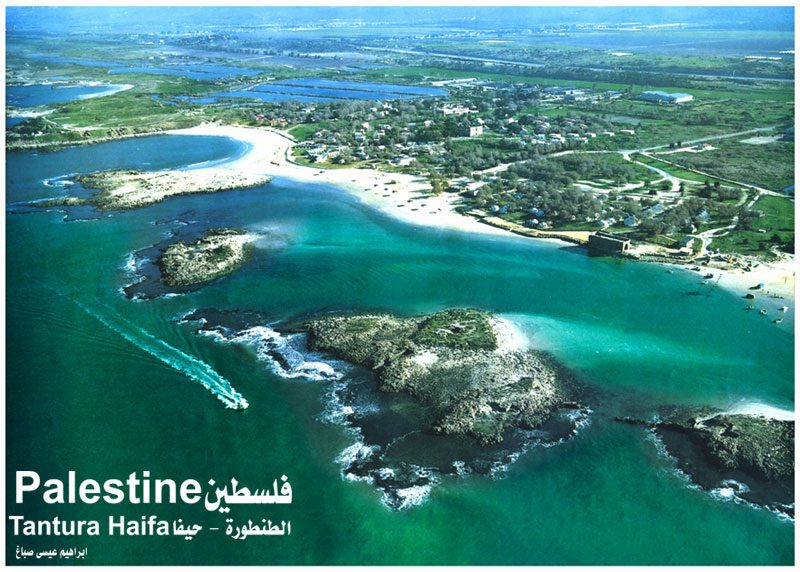
The village generally extended from north to south, while the marshes to its east prevented expansion in that direction. The shoreline around the village was covered with sand dunes. In 1931, the village had 300 stone houses and two other structures, and its built-up area covered 119 dunams in 1945. The total area of the village and its lands was 14,520 dunams, of which Zionists owned 14.12 percent.
In 1922, Al-Tantura had approximately 750 Arab inhabitants. Their number increased to 953 in 1931, including one Jewish resident, and reached 1,490 in 1945.
The village had an elementary school for boys and another for girls. Its economy depended on the cultivation of grains, field crops, and fruit trees, as well as fishing. In 1943, approximately 260 dunams were planted with orange trees, concentrated southeast of the village, while olive trees were cultivated on only 20 dunams. The quantity of fish caught increased from 6 tons in 1928 to 1,633 tons in 1944.
The Zionists displaced the Arab inhabitants of the village and destroyed it in 1948. The following year, Jewish immigrants from Greece established the Doron moshav on the site of the village. Its population reached 170 in 1970. In addition, Jews who had come from the United States and Poland established Nahsholim Kibbutz in 1948, approximately one kilometer north of the village site. Its population reached 253 in 1970.
Source: The Palestinian Encyclopedia