February 26, 2022
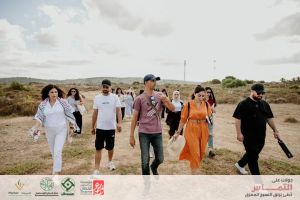
On Friday, the Zochrot Association organized an educational tour of the Palestinian depopulated village of Tantura, located on the Mediterranean coast south of Haifa and west of the village of al-Fureidis. The tour aimed to explore the village’s history and Nakba, its occupation and ethnic cleansing, and the massacre carried out by Israeli forces against its inhabitants.
Tantura was home to 1,720 people before the Nakba and had approximately 14,000 dunams of agricultural land. The villagers relied on farming and fishing before the village was occupied by the Israeli army in May 1948.
Today, the house of Ahmad al-Yahya and the school, along with the shrine of Sheikh al-Bujayrimi, which stands inside a tourist resort, are virtually all that remains of the village. Most of its inhabitants were displaced to refugee camps throughout the Arab world, while some remained in al-Fureidis and other towns inside historic Palestine.
Today, Tantura has some of the most beautiful beaches in the area. The settlement of Nahsholim was established on its lands, along with a hotel, a tourist resort, and a fishing village used by fishermen from al-Fureidis.
The educational tour began at the parking lot, which had been the site of the massacre in 1948, and then proceeded to the mass grave of the victims of the Tantura massacre. The participants placed a sign reading “Tantura Cemetery.” They then stopped at the site of the mosque on its southeastern side, where another sign bearing the mosque’s name was placed. The group then continued toward the seashore, eventually reaching the only surviving Palestinian house in the village, belonging to Ahmad Yahya, and the shrine of Sheikh al-Bujayrimi inside the tourist resort.
In this context, Omar al-Ghabari, the tour guide from Zochrot, said:
“We are standing on the land of the Tantura cemetery. It begins at the parking lot and ends inside the parking area belonging to the Nahsholim Hotel, which was built on Tantura’s land immediately after 1948. Imagine that the cemetery is beneath people’s feet, yet the hotel owners do not dare tell visitors the story.”
Al-Ghabari also discussed the debate sparked by Tantura, the recent film by director Alon Schwarz, released in Hebrew, which “reveals the Tantura crime and includes testimonies from criminals who took part in it.” He added:
“As Palestinians, we must seize this opportunity to accumulate knowledge about the Nakba, its crimes, and the Tantura massacre.”
Al-Ghabari added:
“The village of Tantura is known as one of the beautiful villages that once stood along the Palestinian coast, according to testimonies we have heard from refugees and even from Israeli settlers who described the village, its houses, and its attractive architectural style… Unfortunately, the beautiful description of the town is now linked to the horrific massacre and the shock and tragedy it inflicted upon this village.”
Al-Ghabari recalled the brutality of the massacre and the killings and executions of men and women:
“We are talking about 200 to 250 victims, including the two women, Izzat al-Hajj and her sister…”
For her part, Rachel Bat-Aryeh, director of the Zochrot Association, said:
“We see the Israeli society’s denial of the crimes of the Nakba, and this continues to this day. The Nakba continues every day. Yesterday, the child Muhammad Shahada from the village of al-Khader was killed. Our role is to educate a generation and remind it of the crimes of the Nakba and of the right of return in a serious manner.”
“Visiting Tantura is not merely about learning history; it is an activity and a call for recognition of the truth and responsibility for it, and a call to establish justice through implementing the right of return and rebuilding Tantura,” according to a statement issued by Zochrot.
The statement added:
“Tantura is not merely a film, nor is it a chapter of history that has passed. It is an open wound and an ongoing injustice. The Tantura massacre and the displacement of its inhabitants were not an isolated crime or an exceptional event, but rather one chapter of the bloody and ongoing Nakba.”
Source: Al-Araby Al-Jadeed