After a year and a half of documentation and investigation, a report will be issued tomorrow, Wednesday, by the Tantura Residents Committee, Adalah Legal Center, and Forensic Architecture International, concerning the locations of the mass graves and testimonies from survivors of the Tantura Massacre committed by Zionist militias during the Nakba in 1948.
The report, titled “Tantura,” also contains archival materials, oral history maps, and photographs of the village located south of the city of Haifa before the Palestinian Nakba.
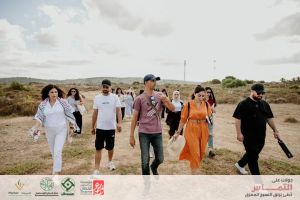
In parallel, the Committee of Displaced Tantura Residents, Adalah Legal Center, and Forensic Architecture International organized a tour today, Tuesday, of the displaced village of Tantura. They visited the mass graves they had worked to uncover, which contain more than 250 victims who were killed during the massacre.
The participants in the tour identified the first mass grave, which has been turned into a parking lot belonging to a resort on the beach south of Haifa, and no trace of the grave remains.
The Zionist militias committed a mass massacre in the village of Tantura on May 22 and 23, 1948, killing more than 200 people in cold blood.
The land area of Tantura was 14,520 dunams. Its population was estimated at around 750 in 1929 and approximately 1,490 in 1945, before the armed Zionist militias destroyed the village and displaced its inhabitants, whose number in 1948 was approximately 1,728.
Attorney Suhad Bishara of Adalah Legal Center explained in an interview with Al-Araby Al-Jadeed that the tour carries “a historical, legal, and political message, namely the right to honor the dead and not violate their dignity by desecrating graves and cemeteries.”
She explained: “Therefore, we identified some of the cemeteries, mass graves, and burial grounds that existed in the village before the Nakba. This was based on a precise investigation using advanced technologies by Forensic Architecture. For the first time, we were able to accurately determine the locations of the graves.”
She emphasized the need “to demand respect for those graves in the town of Tantura and to allow the people of Tantura, in a dignified manner, to visit their victims and pray for them according to their religious rites, and to stop violating the sanctity of the graves and the dignity of the dead and their families.”
She noted that “Adalah will send an official letter accompanied by the report and documents confirming the existence of these graves, and it will be issued in the name of the people of Tantura.”
The field tour also continued to the location of the second mass grave, which is now situated inside an Israeli resort.
In an interview with Sami Al-Ali, coordinator of the Tantura Residents Committee, he said: “Today we are conducting a tour ahead of the publication and release of the first investigation in the history of our Palestinian people to reveal the mass graves in the village of Tantura.”
He pointed out that “these mass graves contain more than 250 male and female victims who were killed during the massacre committed by the Zionist militias, particularly the Alexandroni Brigade, in 1948.”
Al-Ali added that “during today’s tour, based on the findings of the investigation, we mapped the boundaries of the graves and their exact locations.”
He revealed that “today we identified four main burial sites in addition to the historic cemetery that we can see in aerial photographs.”
According to Al-Ali, “aerial photographs from before 1948 confirm the existence of a historic cemetery in the heart of the village of Nachsholim, on the ruins of the village of Tantura, where tourist resorts and infrastructure were built to erase the landmarks and everything that bears witness to and confirms the occurrence of the Tantura massacre.”
He added that “the third mass grave site was behind the home of the Yahya family, which is the only house whose remains still exist in the village.”
For her part, Jihan Sarhan, a displaced resident of Tantura, confirmed “that members of her family and her uncle were among the victims of the massacre.”
According to Sarhan’s testimony, “young men from the age of ten to 55 were executed. As for the women, they were gathered on the beach and left without water or shelter.”
She added, “The neighborhood was looted, the survivors were stripped of everything, and they were expelled from their village.”
In her statement, she called on “Israel to acknowledge the massacre before the world, honor the victims, identify the mass graves, and plant them with flowers so that we can recite Al-Fatihah and bury them according to Islamic law. This is the least duty we can fulfill.”
The fourth mass grave was adjacent to the historic cemetery of the village, on which the Nachsholim Hotel now stands.
Kamal Khaled Masri Al-Atrash, one of the displaced residents of Tantura, said that “the victims, my grandfather Suleiman and my uncle Issa, are buried with the victims in the Tantura cemetery.”
He added, “We were displaced to the village of Fureidis, while most of my relatives were displaced to Syria.”
He recounted in an interview with Al-Araby Al-Jadeed that “we lived the most beautiful life in Tantura. My mother studied up to the fourth grade at Tantura School and was fluent in English.”
Meanwhile, Musa Hassadiya, a member of the Tantura Residents Committee, stated that the person who “first published reports about the massacre was journalist Mohammed Hosni on the Kul Al-Arab website in 1992, and he conducted interviews with survivors.”
According to Hassadiya, “after the massacre, the victims’ bodies were left on the ground and no one took care of them. A week later, the foul smell became overwhelming, and orders came from Jerusalem to deal with the matter. They brought people from the village of Fureidis to collect the bodies, which had decomposed, and then buried them in mass graves.”
Journalist Mohammed Hosni Kaoush of the local Kul Al-Arab newspaper was the first to reveal the Tantura massacre and the mass graves in 1992, after which he was threatened by the Israeli establishment to stop publishing.
Source: Al-Araby Al-Jadeed