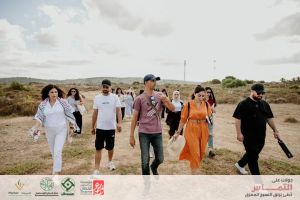
On Wednesday, November 30, 2019, European Union Ambassador Emanuel Giaufret, accompanied by Colin Scicluna, Head of the Mashriq Division at the European External Action Service, visited the village of Jisr az-Zarqa to learn about the conditions and challenges facing the community.
The visit was part of a community development program implemented by the local council in cooperation with the European Union, Mossawa Center, the Faculty of Law at Tel Aviv University, and the Arab Center for Alternative Planning. The program is overseen by Ms. Ghussoun Bishara, the EU Community Programs Officer, who also coordinated the visit.
Scicluna was visiting the region to learn about developments following the parliamentary elections. During his visit, he also met with representatives of the Palestinian National Authority and the Israeli government.
The delegation met with the head of the local council, Sheikh Murad Ammash, and members of the council’s staff to hear about the challenges facing the town. The European Union has agreements with the Israeli government covering political, human rights, and economic issues, including a provision concerning respect for human rights.
Organizations involved in the program presented the legal, parliamentary, and media advocacy tools they use to advance the rights of Jisr az-Zarqa residents, in cooperation with local institutions and the local council. Dr. Thabet Abu Ras, representing the Abraham Initiatives, presented a proposal concerning the introduction of a police station in the village.
The delegation also visited several facilities and initiatives in Jisr az-Zarqa, including Galeria and the “Juha” guesthouse, where they met with its founder, Ahmad Juha, and activist Sa’da Jarbaan. The delegation learned about tourism, educational, and women’s initiatives being implemented in the village.
The delegation then toured different neighborhoods, visited the beach and the fishermen’s village, and learned about the harbor development project. They also spoke with fishermen and local entrepreneurs operating in the coastal area.
The delegation was briefed on the challenges facing the village, including its geographical isolation between the separation barrier near Caesarea, the surrounding kibbutz ponds, and Highway 2.
Attorney Hisham Shbaita of the Human Rights Clinic at Tel Aviv University and Shadi Khalileh of the Arab Center for Alternative Planning briefed the delegation on the planning and infrastructure challenges facing the town.
The delegation was accompanied by Marai Yassin, an entrepreneur working to promote tourism guidance and hospitality in the village. He introduced the delegation to the Hi-Tech Café, which provides people with the opportunity to work on computers while sitting by the sea.
The head of the local council expressed his satisfaction with the international attention being given to the village’s situation.
“We concluded an important field tour and working session with the European Union ambassador, who visited our town to learn about the progress of the ‘Helping the Jisr az-Zarqa Community Overcome the Crisis’ program. The program includes a financial grant that we received from the European Union a year and a half ago, and its implementation continues through a partnership with Mossawa Center, the Arab Center for Alternative Planning, and the legal clinics at Tel Aviv University.”
The program coordinators, Marwa Zoabi and Henn Kranetzky, presented an overview of the program, which covers health, education, rights advocacy, tourism, and marketing, in addition to advocacy efforts aimed at securing government budgets.
The delegation was accompanied by Mossawa Center Director Jafar Farah and International Relations Coordinator Wasim Nasser.
The council head added:
“Visiting the town, walking through its streets, and seeing its institutions and facilities helps us break out of the state of isolation imposed upon us. We concluded the field visit with a discussion about the future of the village, presenting the obstacles to its development and seeking the European Union’s support for projects and its continued involvement in raising these issues with state institutions.
We are working with determination and hope for a dignified and prosperous future for our town, because it deserves all our efforts.”